


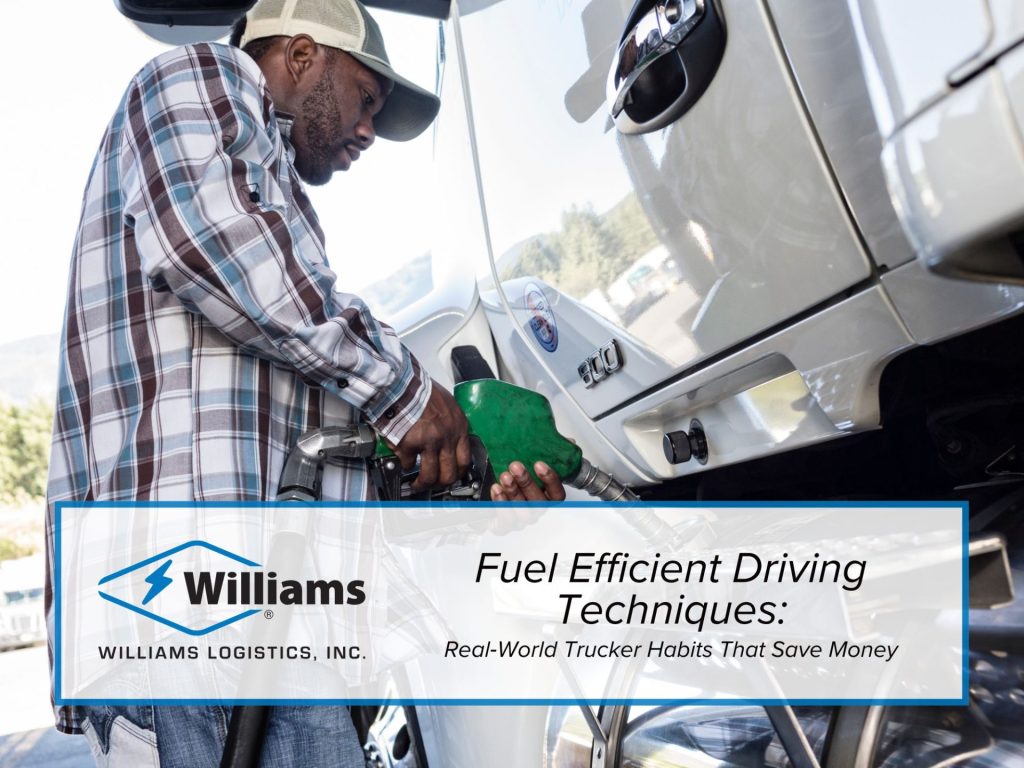
When diesel costs jump, everyone suddenly has an opinion about how to improve fuel efficiency. Some of that advice is solid; some of it ignores what actually happens in a loaded truck running real routes. At Williams Logistics, we want to focus on what you can control every day—without pushing myths that don’t match real‑world results.
A recent fuel‑efficiency piece highlighted eight key areas fleets can work on: idle time, speed management, aerodynamics, tire care, maintenance, trip planning, driver behavior, and technology. Those big buckets are right—but the way you apply them in the seat matters more than any generic rule.
Speed: Safety and Law First, Efficiency Second
Any discussion of speed has to start here: the first priority is always safe, legal speed for conditions. You never trade safety or hours‑of‑service compliance for a few tenths of a mile per gallon. Period.
So instead of chasing a magic number, use speed this way:
- Stay within posted limits and what’s safe for weather, traffic, and terrain.
- Avoid unnecessary speeding that burns fuel without meaningfully improving your schedule.
- Use cruise control where it’s safe to maintain a steady, legal speed and reduce constant throttle changes.
Safe, steady speed and smooth control often line up with better fuel economy; they’re not in competition.
Throttle Control and Momentum: Where Drivers Really Make Money
Drivers who own and run their own iron will tell you the same thing: idle and technique beat theory. Many fuel‑efficiency coaches see in research data that:
- Aggressive throttle and hard braking can cut economy by 15–30% at highway speeds.
- Gentle throttle, early lift‑off, and using momentum over small hills consistently improve mpg, even at the same average speed.
Practical fuel efficient driving techniques you can use today:
- Let gravity help you: ease into grades with a light throttle and let momentum carry you over smaller hills instead of hammering it the whole way.
- Feather the throttle. Use only as much pedal as the load and terrain need. Avoid mashing it off lights or when traffic starts to move.
- Look far ahead and protect space. More following distance lets you coast into slowdowns instead of jumping on the brakes and re‑accelerating—where each acceleration costs fuel.
Idle and Planning: Quiet Fuel Killers You can Control
Across fleets, idle is often the single biggest controllable fuel drain. A heavy‑duty truck can easily burn around 0.8 gallons per hour sitting still. Over weeks, that’s hundreds of dollars out of the tank with 0 miles to show.
Actionable habits:
- Shut down when you’re parked and it’s safe to do so, rather than idling out of habit.
- Use APUs or bunk heaters where available instead of letting the main engine idle for comfort.
- While luck plays a role in today’s truck parking shortage, thoughtful trip planning can still give you a better shot at safe, legal parking.
Trip planning and routing also matter: fewer unnecessary miles and less time in stop‑and‑go congestion mean better efficient fuel consumption without changing anything else. While mapping likely stops ahead of time helps you estimate the best areas to shut down so you’re not burning fuel circling for last‑second spaces.
The bottom line: there is no one magic fix. Real fuel savings come from professional habits—safe, legal speeds, smooth throttle and braking, smart use of momentum, low idle, and solid planning. Those are skills you already use to stay safe; refining them just puts more of each gallon to work for you.